Managing product data across multiple channels can be one of the most time-consuming challenges for ecommerce businesses. As catalogs grow in size and complexity—especially for merchants with configurable products, technical attributes, and multilingual content—the need for a centralized Product Information Management (PIM) system becomes clear. Perfion is a popular PIM solution that provides flexible data modeling, multi-language content support, and efficient product enrichment workflows. When integrated properly with Magento 2, Perfion can serve as the single source of truth for product information, ensuring consistency and accuracy across all digital sales channels.
In this article, we’ll look at how to integrate Perfion with Magento 2, what Perfion’s official Magento connector provides, and best practices to ensure your integration is scalable and reliable. 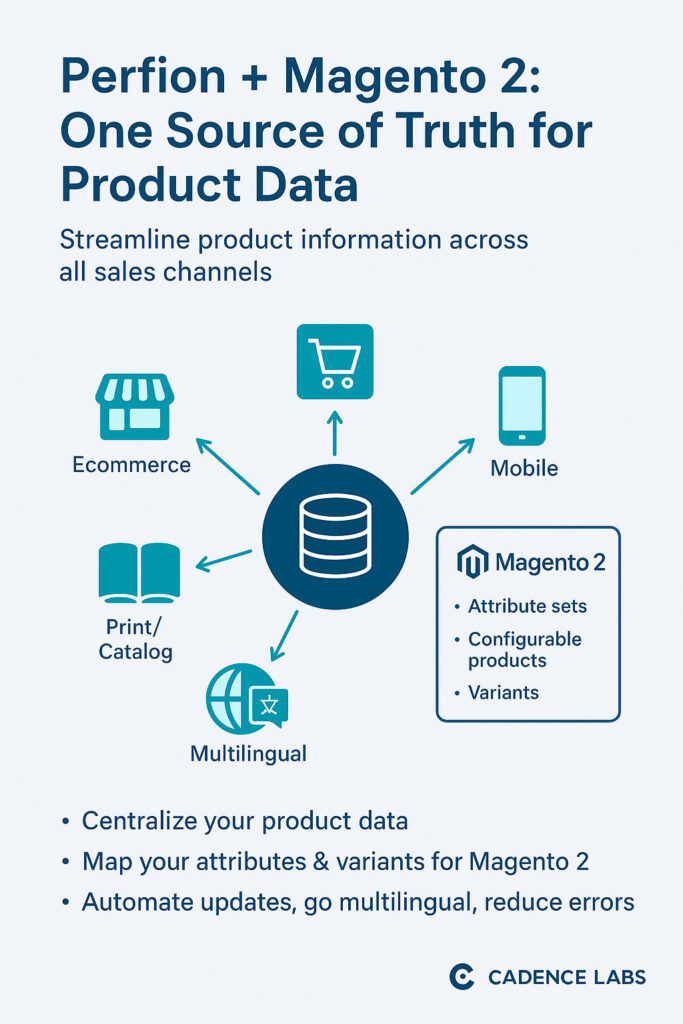
Why Use Perfion with Magento 2?
Magento 2 is a powerful ecommerce platform with deep native support for product attribute sets, configurable products, categories, and custom data. However, Magento is not designed to serve as a full product content management repository. This is especially true when product data needs to be:
- Maintained across multiple sales channels (e.g., ecommerce, marketplaces, ERP systems, print catalogs)
- Enriched by multiple teams (marketing, technical, supply chain, etc.)
- Translated into numerous languages or localization variants
- Frequently updated with spec sheet changes, pricing updates, or new variants
This is where Perfion excels. Perfion acts as the single authoritative source, while Magento becomes the distribution and presentation layer. The result is faster catalog updates, fewer product data inconsistencies, and significantly reduced manual effort.
Perfion’s Magento Connector
Perfion provides an official connector that facilitates syncing product data from Perfion to Magento 2. The connector allows for:
- Automated import of product data, attributes, and relationships
- Mapping Perfion data models to Magento attributes, attribute sets, and categories
- Synchronization of multi-language fields to Magento’s store view system
- Support for configurable and variant-based product structures
- Scheduled updates to maintain catalog freshness
Organizations can choose between one-way synchronization (Perfion → Magento) or more advanced configurations where certain fields (e.g., pricing or inventory) are overridden by an ERP or external source.
Key Integration Considerations
1. Attribute Modeling and Data Mapping
A clean and deliberate attribute structure is essential. Magento 2 requires products to belong to an Attribute Set, and each store may require unique attribute values. Before integration, you’ll want to:
- Standardize your attribute naming conventions
- Ensure attribute types in Perfion correspond to Magento’s attribute input types
- Determine which system controls which data fields
For example, marketing descriptions may originate in Perfion, while price or stock data may still come from an ERP or POS backend.
2. Handling Configurable Products and Variants
Perfion is well-suited to storing product families, specs, and variant attributes. The connector can generate Magento Configurable Products automatically—creating parent SKUs and linking child simple SKUs.
The important piece is ensuring consistency in variant-defining attributes (e.g., size, color, finish). Magento requires these attributes to be global and configured for use in configurable products, so your attribute modeling in Perfion should account for this.
3. Synchronization Performance and Batch Sizes
For larger catalogs (10,000+ SKUs), performance optimization is essential. This can include:
- Incremental sync (only update changed products)
- Cron-based scheduling instead of real-time updates
- Index queue optimization for Magento’s product and search indexing
A properly tuned system avoids bottlenecks during product imports or nightly updates.
Example Workflow
Here is a simplified example of how your integration flow might look:
- Product content is created and enriched in Perfion.
- A scheduled export triggers via Perfion’s connector.
- Data is pushed into Magento’s product API endpoints.
- Magento reindexes product, inventory, and search indexes.
- Updated content appears on the storefront and other downstream channels.
Conclusion
Integrating Perfion PIM with Magento 2 allows ecommerce teams to manage product data far more efficiently and consistently across omnichannel storefronts. Perfion’s official Magento connector simplifies much of the heavy lifting—however, a successful integration still requires thoughtful attribute modeling, workflow planning, and system tuning.
Cadence Labs has helped merchants integrate Perfion and other PIM systems with Magento 2 and Shopify, including custom attribute mappings, multilingual store rollouts, and ERP workflow coordination. If you’d like help planning or implementing your integration, feel free to reach out—we’d be happy to discuss your project needs.