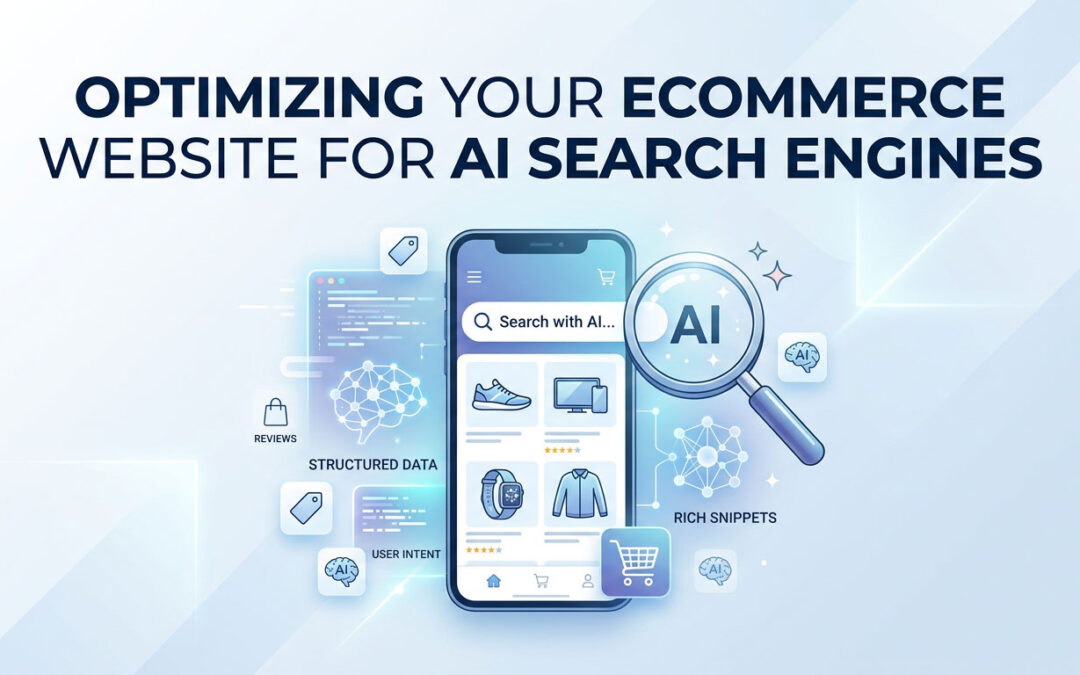
If you own or manage an ecommerce website you have likely seen a change to your organic search traffic due to the roll out of new AI search results. Appearing at the top of the page AI results are driving more traffic and need to become a part of any business’s online marketing strategy. Gartner projected a roughly 25% drop in traditional search engine volume by 2026, and many of the businesses Cadence Labs works with have seen this prediction become a reality.
For an ecommerce store, that means your marketing strategy and goals have changed dramatically. You no longer just need to rank; you need to be cited, summarized, and recommended inside an AI-generated answer. That practice has a few names: Generative Engine Optimization (GEO), Answer Engine Optimization (AEO), or just AI search optimization.
First, let’s understand what AI search is
Traditional Search Engine Optimization (SEO) rewards a page that matches a keywords and has authority signals pointing at it. AI search behaves more like a researcher, it reads a query like “best waterproof hiking boots for wide feet under $200” builds a shortlist of candidate products, pulls structured attributes from feeds and pages, weighs third-party opinion (reviews, forums, editorial), and synthesizes a recommendation for the user.
That means two things. First, keywords matter less than attributes and context. Second, your brand’s reputation outside your own domain, which includes things like reviews, mentions, comparisons, Reddit threads, is doing real work towards getting your product mentioned.
So what should you focus on in 2026 to get your product or website featured by AI?
Write original content!
This is still as true for GEO/AEO as it is for SEO. Having generic, manufacturer-supplied descriptions doesn’t help you stand out. Especially if they are nearly identical across thousands of competing retailers, LLMs have no reason to prefer your website. Original, specific copy is what gets picked up and quoted.
A few patterns that we have found that work:
Write content around a context for a user. “A 20x20x1 furnace filter for allergies with lower electricity costs” is more citeable than “20x20x1 furnace filter”. Write a short, direct answer to the obvious questions a buyer would ask — fit, durability, what is in the box, what it does not do in the first 100 words of the page. AI systems are biased toward content that resembles a clear answer, because that is what they are trying to produce.
Include a real FAQ section, with questions phrased the way customers ask them out loud. Your customer service team is a great asset here for getting ideas and generating content.
Create user guides and tutorials with clear step by step instructions. AI likes to quote specific steps so the more direct and useful you can be around providing step by step instructions the better.
Check that your site is readable by AI crawlers
Several practical points often get missed. Confirm that your robots.txt allows the crawlers you care about such as GPTBot, ClaudeBot, PerplexityBot, Google-Extended, and others. You may have had specific reasons to block them or to rate limit them if they are causing issues with server resources. Blocking them entirely removes you from the index they build answers from.
Keep Core Web Vitals healthy. Speed and stability still matter, both for traditional ranking and because slow pages are sampled less reliably.
Build authority off your own domain
An AI’s recommendation is shaped heavily by what the rest of the internet says about you. If a model has read 200 enthusiastic reviews of your product on independent sites, a thoughtful Wirecutter mention, an active subreddit thread, and consistent third-party retailer listings, you become a default citation. If it has read only your own marketing copy, you are easy to skip.
Concrete actions: encourage and respond to reviews on Google, Trustpilot, and category-specific sites. Get listed in legitimate “best of” roundups and buying guides. Make your product available — with consistent naming and attributes — on the marketplaces your category lives on. Earn editorial mentions in publications your customers read. Treat PR and review-seeding as part of your AI search strategy, because they are.
Prepare for agentic commerce
The next step beyond AI-generated answers is AI-driven purchases. Tools like ChatGPT’s agent mode and Perplexity’s shopping features are beginning to complete transactions on behalf of users. To be eligible, your site needs to be navigable by an automated agent: predictable URL structures, clean cart and checkout flows that do not require unusual interactions, accurate real-time inventory and pricing, and ideally a feed that integrates with whichever shopping protocols your platform supports (Google Merchant Center, OpenAI’s product feed program, etc.).
Measure what you can
AI search analytics are immature so you’ll need to watch for referral traffic from domains like chat.openai.com, perplexity.ai, gemini.google.com in your analytics. Run periodic prompts on the major AI tools yourself and ask questions your customers would ask and record whether you are mentioned, and how. Track branded search volume as a proxy for AI exposure; brands that get cited in AI answers see branded search rise even when total organic traffic falls.
The short version
AI search rewards three things: clean, structured product data that a machine can parse without ambiguity; original, specific, answer-shaped content that is worth quoting; and third-party authority that tells the model you are a credible recommendation. The good news is that the work overlaps almost entirely with what makes a store better for human customers. The brands that invest now will compound the advantage as more shopping shifts into the conversational layer.